Traveling the Hypnosis Conference Season: How to Save Money, Save Time, and Travel Safer This Fall & Winter

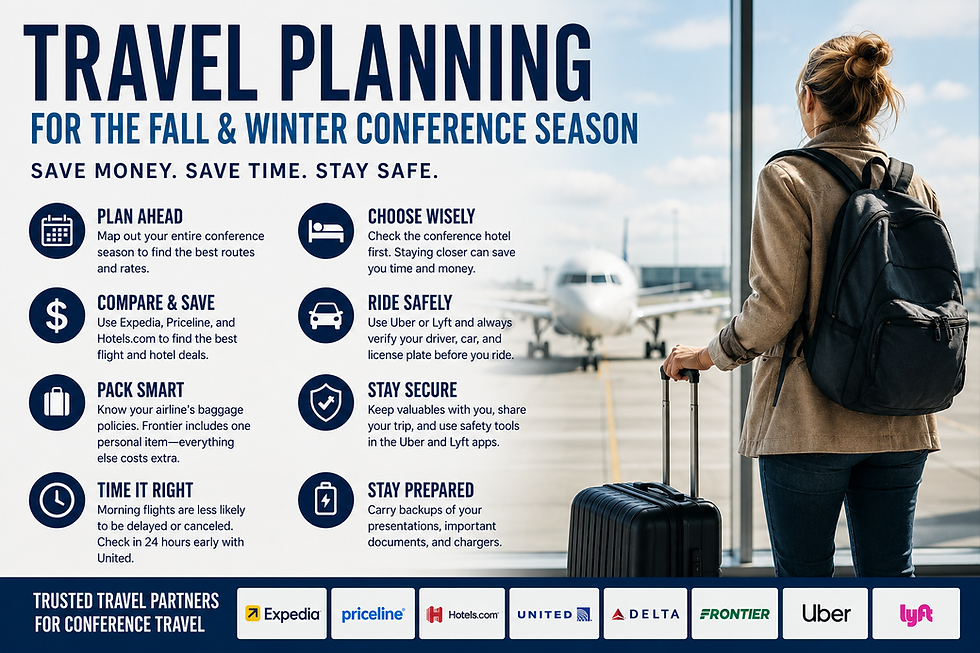
The fall and winter months are becoming one of the busiest times of the year for the hypnosis and hypnotherapy community.
From Detroit to Toronto, Las Vegas, and other conference destinations, practitioners, educators, presenters, and exhibitors may find themselves traveling to multiple events within just a few months. That can be exciting—but it can also become expensive, exhausting, and stressful if travel isn’t planned strategically.
The good news is that conference travel doesn’t have to break the bank.
With a little advance planning, flexible booking, smarter packing, and attention to personal safety, you can spend less time worrying about transportation and more time learning, networking, presenting, and building relationships.
Here are our top travel tips for navigating the Hypnosis Conference Fall & Winter Season.
Start Planning Before You Start Booking
One of the biggest mistakes conference travelers make is treating every conference as an individual trip.
Instead, look at the entire season. Create a calendar showing:
Conference dates, city and venue, arrival date, departure date, nearest airport, hotel options, flight options
Ground transportation, expected travel costs.
Presentation or workshop commitments
Once you see the entire season on one calendar, you may discover opportunities to combine trips, stay an extra night instead of making an expensive same-day turnaround, or use a different airport.
This is particularly important for presenters who may be traveling with presentation equipment, marketing materials, books, demonstration supplies, or vendor materials.
Think of the conference season as one travel plan—not five separate trips.
Take Advantage of the Fall Shoulder Season
Fall can be an excellent time for travel because it sits between the heavy summer travel season and the major winter holiday period.
Expedia’s 2025 Fall Travel Outlook found that shoulder-season travel can bring lower airfare and accommodation prices, while its 2026 Air Hacks research continues to show that travelers can find meaningful savings by being flexible about when they fly. Expedia’s 2026 research also identifies September as one of the more affordable months for travel and highlights less-crowded travel days as an opportunity for travelers. (Expedia)
For conference travelers, flexibility can mean:
Instead of: Flying Saturday morning and returning Sunday night.
Consider: Arriving Friday, attending the conference, staying Sunday night, and flying home Monday.
Sometimes an additional inexpensive hotel night can save you from paying significantly more for a last-minute flight—or give you a much less stressful journey.
Compare More Than One Booking Site
Don’t automatically book the first flight or hotel you find.
Use several services to compare the total cost.
Expedia can be useful for comparing flights, hotels, packages, and flexible hotel options. Expedia also offers price tracking and flight-and-hotel packages. (Expedia)
Priceline offers flights, hotels, packages, and its Express Deals and Pricebreakers products. Priceline currently promotes savings through bundled flight-and-hotel bookings, although travelers should understand that some Express Deals do not reveal the exact hotel or airline until after booking. (Priceline)
Hotels.com is another useful comparison point when looking specifically at lodging.
Don’t compare only the advertised room or airfare.
Compare the final trip cost:
Airfare + baggage + hotel + airport transportation + parking + meals + resort/destination fees + transportation to the conference.
A $129 flight isn’t necessarily cheaper than a $159 flight if the first airline charges significantly more for bags and seat selection.
Don’t Forget the Hotel Cost Per Night
Hotel pricing can change dramatically depending on the night of the week.
Hotels.com’s 2026 Hotel Price Index found that Sunday is currently one of the more affordable nights for hotel stays, while Friday and Saturday tend to command higher prices. The same report found that travelers booking within about a week of their stay can sometimes find significant savings. (hotels)
That doesn’t mean you should always wait until the last minute.
For conference travel, availability matters.
A conference hotel can sell out even when other hotels in the city have rooms available.
A better strategy is to look for: Free cancellation, Pay-later options.
Conference hotel blocks, Loyalty discount, Member rates, Breakfast included, Free airport shuttle, Free parking
Wi-Fi included, no resort fee
Reasonable transportation to the venue
Expedia specifically recommends looking for refundable hotel reservations and flexible cancellation policies when planning fall travel. (Expedia)
Check the Conference Hotel Before Booking Somewhere Else
The cheapest hotel isn’t always the cheapest trip.
Suppose Hotel A costs $30 less per night but requires a $25 rideshare each way to the conference.
Hotel B might cost $30 more but is within walking distance of the conference venue.
Over three days, Hotel B may actually save you money.
And there is another advantage:
Time.
Staying at or near the conference venue means you don’t have to worry about traffic, parking, rideshare availability, or getting back to the hotel late at night.
For conference presenters, this can be especially valuable.
Consider Bundling Your Flight and Hotel
Both Expedia and Priceline promote flight-and-hotel packages as a way to reduce the overall cost of a trip potentially.
Expedia reports that travelers can save by booking flights and hotels together, while Priceline currently advertises package savings as well. (Expedia)
However, don’t assume a package is automatically cheaper.
Do a quick comparison:
Flight + Hotel separately
versus
Flight + Hotel package
Then compare the cancellation policies and what is actually included.
A $600 package isn’t necessarily a bargain if the hotel has restrictive cancellation terms or the airfare doesn’t include the baggage you need.
Watch Your Baggage Costs
For conference presenters, baggage can become one of the hidden expenses of the season.
If you’re carrying Marketing materials, books, printed handouts, clothing, presentation equipment Vendor materialsPromotional productsyour baggage strategy matters.
Frontier Airlines is particularly explicit about this. Frontier includes one personal item with its fares, while carry-on and checked baggage are additional purchases. The airline states that purchasing bags during booking or before arriving at the airport can save money compared with waiting until the airport. (Frontier Airlines)
Frontier’s current personal-item limit is 18 × 14 × 8 inches, while its standard carry-on limit is 24 × 16 × 10 inches. (Frontier Airlines)
That means you should measure your bag—not assume it qualifies.
A conference travel trick:
If you’re traveling to several conferences, consider shipping bulky promotional materials ahead of time when the economics make sense.
Sometimes paying for a package is cheaper—and easier—than transporting several heavy bags through multiple airports.
Carry the Important Things With You
Never put your most important conference materials in checked luggage.
Your Passport or identification Wallet Medication Laptop Phone Chargers Presentation files, backup drive, conference credentials, business cards Important documents
should stay with you.
Frontier specifically advises passengers not to place medication, cash, electronics, car keys, important documents, or valuables in checked baggage. (Frontier Airlines)
Delta likewise advises travelers to make sure their name is somewhere on their baggage and notes that baggage rules can vary depending on the flight and partner airline. (Delta)
For presenters, make your presentation portable.
Keep a copy on your laptop, on a USB drive, in cloud storage, in your email
If your checked bag disappears, your presentation shouldn’t disappear with it.
United: Check In Early
United allows passengers to check in beginning 24 hours before scheduled departure, although minimum check-in, baggage, and boarding requirements vary by airport and destination. (United Airlines)
Make online check-in part of your conference travel routine.
The night before your flight
Check in, confirm your seat, review your baggage, check the flight status, save your boarding pass.
Charge your phone. Confirm your transportation to the airport. This takes only a few minutes and can prevent unnecessary scrambling the next morning.
Look at the Total Cost When Comparing Airlines
There is no universally “cheapest” airline.
The cheapest airline depends on what you need.
Delta, United, and Frontier all have different fare structures and baggage policies.
Delta, for example, notes that checked-bag fees depend on factors including destination, booking date, and travel experience. (Delta)
Frontier uses an à-la-carte model in which the personal item is included, but additional bags can cost extra. (Frontier Airlines)
So when comparing flights, ask:
What will this flight actually cost me from my front door to the conference hotel?
That is the number that matters.
Morning Flights Can Be Worth Considering
Getting to a conference is not simply about finding the lowest airfare.
It’s about arriving when you need to arrive.
Expedia’s 2024 research found that morning departures were less prone to cancellations than flights departing later in the day. (Expedia)
For a conference presenter, that matters.
If your presentation begins at 9:00 a.m. Saturday, arriving at 11:30 p.m. Friday because you found a cheaper flight may not be the smartest strategy.
If you are presenting, consider arriving at least one day early whenever your budget allows.
A delayed flight is inconvenient.
A delayed flight that causes you to miss your own presentation is a completely different problem.
Build a Travel Buffer Between Conferences
One of the biggest mistakes frequent conference travelers make is scheduling everything too tightly.
If Conference A ends Sunday afternoon and Conference B begins Monday morning in another city, you have created a fragile travel schedule.
A delayed flight, missed connection, weather problem, or transportation issue can affect the entire week.
Whenever possible, create a buffer.
Your goal should be:
Arrive early enough that a normal travel problem doesn’t become a conference emergency.
This is particularly important during late fall and winter, when weather can create additional travel disruptions.
Use Rideshare Strategically
Uber and Lyft can be excellent tools for getting from airports to hotels and conference venues—but don’t assume they’re always the cheapest option.
Before requesting a ride, compare
Uber Lyft Hotel shuttle Airport shuttle Public transportation Walking
Rental car Conference transportation
For one person, rideshare may make sense.
For three or four conference attendees traveling together, splitting a ride can make it considerably more economical.
Your Rideshare Safety Matters
Traveling alone for conferences means you need to take personal transportation safety seriously.
Uber recommends requesting rides from inside when possible and checking the vehicle’s license plate, make and model, and driver photo before getting into the vehicle. Uber also recommends sitting in the back seat when possible and wearing a seat belt. (Uber)
Uber’s Canadian safety information also includes tools such as emergency assistance, trip sharing, GPS tracking, anonymous communications, and ride verification features. (Uber)
Lyft provides similar safety tools, including location sharing, audio recording, scheduled check-ins, PIN verification, real-time ride monitoring, and 24/7 safety support. (Lyft)
When getting into a rideshare:
Check the car.
Check the plate.
Check the driver.
Check the app.
If something doesn’t match, don’t get in.
Share Your Travel Plans
If you’re traveling alone, give someone you trust your basic itinerary.
They don’t need every detail.
Simply provide: Conference location, Hotel, Flight information, expected arrival
Expected departure
Use the location-sharing tools available through your rideshare app when appropriate.
Lyft, for example, allows riders to designate trusted contacts who can follow their trip and location in real time. (Lyft)
This is particularly useful when arriving late at night in an unfamiliar city.
Don’t Advertise That You’re Traveling Alone
Conference attendees naturally post about where they’re going.
That’s part of building excitement.
But be careful about broadcasting:
“I’m staying alone at Hotel X from Thursday through Monday.”
You can promote the conference without publishing your exact personal schedule.
Consider posting photos and conference updates while you’re there rather than announcing every detail of your travel plans beforehand.
Pack for Fall—Not Just for the Conference
Fall weather can change quickly.
Your conference wardrobe may be professional, but your travel wardrobe should also be practical. Consider packing: Comfortable walking shoes, Light jacket, Compact umbrella, Layers, Portable phone charger, small backpack, refillable water bottle.
Travel-size toiletries, Comfortable clothing for travel days. Remember that a conference may involve considerably more walking than you expect.
You may walk from:
airport → hotel → conference → dinner → networking event → hotel
all in the same day.
Comfort matters.
Protect Your Energy, Not Just Your Wallet
Conference travel isn’t a vacation. You’re learning. You’re networking. And You’re presenting. You’re meeting clients and colleagues.
You’re often operating at full capacity from early morning until late at night.
That means saving $40 on a hotel isn’t worth it if it leaves you exhausted before your presentation.
Sometimes the best travel decision is spending a little more for:
A direct flight or a closer hotel, a better arrival time, an additional night, a comfortable room, Reliable transportation
The goal isn’t to spend the least possible money.
The goal is to get the best value.
Create a Conference Travel Budget
If you’re attending several events, create one seasonal travel budget.
For each conference, estimate:
Expense | Budget |
Conference registration | $ |
Airfare | $ |
Hotel | $ |
Baggage | $ |
Airport transportation | $ |
Local transportation | $ |
Meals | $ |
Parking | $ |
Miscellaneous | $ |
Total | $ |
Then compare the actual cost after every trip.
You may discover that one of your biggest expenses isn’t airfare at all.
It might be hotel parking, rideshare, baggage, restaurant meals, or last-minute booking.
Knowing where your money is going is the first step toward reducing it.
Make Every Conference Trip Do More
If you’re already traveling several hundred miles to attend an event, maximize the trip.
Consider scheduling:
A networking lunch, a podcast interview, a media appearance
, a business meeting, presentation rehears A visit with another practitioner, a collaboration meeting
One trip can accomplish multiple professional goals.
This is particularly important for independent practitioners who are paying their own travel expenses.
The Conference Travel Formula
For the fall and winter hypnosis conference season, think about travel this way:
SAVE MONEY
Compare Expedia, Priceline, Hotels.com, and the airlines directly.
Look for packages, flexible hotel rates, loyalty programs, price alerts, and lower-demand travel dates.
SAVE TIME
Fly at practical times. Check in early. Pack efficiently. Stay near the conference.
Build travel buffers.
STAY SAFE
Verify rideshare vehicles. Use trip-sharing and safety tools. Keep valuables with you.
Don’t overshare your travel itinerary publicly. Let someone know where you’re staying.
PROTECT YOUR PROFESSIONAL REPUTATION
Arrive prepared. Keep backup copies of presentations.
Don’t allow a delayed flight or missing suitcase to derail your conference commitment.
The Bottom Line
The fall and winter hypnosis conference season is about more than attending events.
It’s about building relationships, learning new techniques, sharing ideas, developing your professional network, and strengthening the hypnosis community.
But you can’t do those things effectively if you’re spending the entire season fighting travel problems.
The smartest conference travelers don’t necessarily spend the least.
They plan. They compare options. They understand the real cost of their trip.
They protect their time. And they make safety part of the travel plan.
So as you prepare for your next hypnosis conference, don’t just ask:
“How much is the ticket?”
Ask: “What’s the smartest way to get there?”
Because during conference season, the journey is part of the experience.
Travel smart. Spend wisely. Arrive prepared. Stay safe. And make every conference count.


Comments