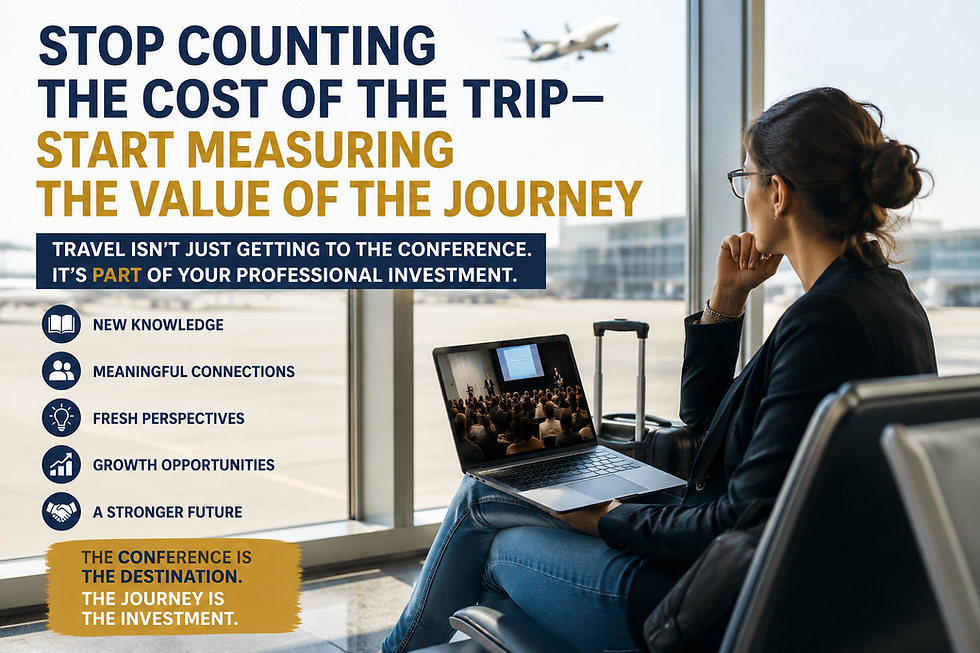
Stop Counting the Cost of the Trip—Start Measuring the Value of the Journey

For many of us working in the hypnosis and hypnotherapy field, deciding whether to attend a conference often comes down to a familiar question:
“Is the conference worth the cost of the ticket, hotel, and travel?”
And this is a reasonable question.
But perhaps we are asking it the wrong way.
Too often, we look at the conference registration fee as the professional investment and then treat airfare, gas, hotel rooms, meals, parking, and other travel expenses as separate costs that make attending more difficult.
But what if we changed the way we look at the entire experience? What if the trip wasn’t simply the cost of getting to a conference?
What if the trip itself was part of the professional investment?
This shift in thinking can change how we evaluate the fall and winter conference season.
The Conference Ticket Is Only One Part of the Investment
A conference registration fee buys access to the event. But it doesn’t necessarily represent the full value of attending. The broader investment may include: Education and continuing professional development; Exposure to new ideas and techniques; Relationships with other professionals; Mentorship; Collaboration; Professional visibility; Business development; New referrals and opportunities; Exposure to different approaches and perspectives; Inspiration and renewed motivation; Time away from the day-to-day routine of practice. And then there is something much harder to put a price on
Being in the room.
By examining the overall opportunities that can come from attending and presenting at conferences in the fall and winter conference season, networking and professional development are among the major reasons professionals attend conferences. Research on professional societies likewise finds that networking can contribute to career development, mentoring, collaboration, and access to knowledge and support.
That means the value of a conference isn’t necessarily contained within the registration fee.
The value comes from the entire experience.
Travel Is Not Separate From the Professional Experience
Consider a hypothetical example. A professional spends:$200 on registration, $ 300 on airfare
$400 on a hotel; $ 150 on meals and transportation
The total investment is approximately $1,050.
It is easy to say “The conference costs $200.”
And then“But getting there is going to cost another $850.”That way of thinking makes the travel feel like a penalty. Instead, consider
“I am making a $1,050 investment in my professional development, relationships, education, and future opportunities.”
That is a very different conversation. The $300 airfare didn’t merely purchase a plane ticket.
It helped put you in the room with people you would not otherwise have met. The $400 hotel didn’t merely purchase a bed.
It made it possible for you to remain immersed in the professional environment for multiple days. And this can have a positive impact on your practice business and within you. The meals weren’t simply food. Some of them may happen while sitting across the table from another hypnotist, presenter, business owner, mentor, or potential collaborator. And the time spent traveling isn’t necessarily lost professional time. It can become part of the experience.
The Value of Being Together
We have become extremely good at sharing information digitally. We can watch presentations online. We can participate in webinars. We can join Facebook groups. We can exchange messages. We can purchase courses. All of these things have tremendous value. But they can’t completely replace being together or what comes from being in the room.
Research examining continuing professional development has found that live conferences can be perceived as offering greater learning value, even though they also carry substantially higher participation costs than online alternatives.
The distinction is important. The question isn’t whether online education is valuable.
It is. The question is whether live professional interaction provides additional value.
There is substantial evidence that it can.
Conference environments create opportunities for informal conversations, mentoring, collaboration, professional identity development, and relationships that can continue long after the event ends.
You can’t always schedule those things. Sometimes they happen because you happened to sit next to the right person at breakfast.
Sometimes they happen in the hallway. Sometimes they happen at dinner.
Sometimes they happen because you decided to stay an extra 20 minutes after a presentation.
Those moments are difficult to put on an expense report.
But they can be professionally significant.
Think Beyond the Three Days
One of the biggest mistakes we can make when evaluating a conference is measuring its value only by what happens while we are physically inside the conference room.
Suppose you attend a conference and learn one technique that improves your work with clients.
What is that worth over the next year?
Suppose you meet someone who becomes a mentor.
What is that worth?
Suppose you develop a relationship that eventually produces a workshop, podcast, referral relationship, collaboration, or business opportunity.
What is that worth?
Suppose you return home more motivated and excited about your profession.
What is that worth?
These outcomes may not happen immediately.
And that’s exactly why conference ROI can be difficult to measure.
Research on conference value has pointed out that some of the most important benefits—particularly networking, inspiration, and changes in professional perspective—are among the hardest benefits to quantify.
That doesn’t make them worthless.
It makes them harder to measure.
The Fall & Winter Conference Season Creates a Unique Opportunity
For professionals in hypnosis, the fall and winter months can be viewed as more than a collection of individual conferences.
They can become a professional development journey.
Instead of asking:
“Can I afford to go to another conference?”
Ask:
“Which professional experiences are worth investing in this season?”
That subtle change can lead to better decisions.
Maybe one conference is close enough to drive.
Another may require a flight. Again, this is an investment, not a penalty.
Another may require taking additional time away from the office.
Instead of automatically eliminating the conference with the higher travel cost, consider the total value of the experience. Who will be there? What will you learn? Who might you meet? What relationships could you develop? What opportunities exist for collaboration? What will you bring home with you?
And perhaps most importantly:
What could change professionally because you decided to go?
Don’t Confuse Cost With Value
This distinction is important.
A $1,000 conference trip isn’t automatically a good investment simply because it costs $1,000.
Likewise, a $150 conference isn’t automatically a better investment because it is cheaper.
Cost and value are two different things.
Research into conference attendance decisions has found that cost and networking opportunities are important factors influencing whether professionals choose to attend and whether they intend to return.
That means cost absolutely matters. We shouldn’t pretend otherwise.
Professionals have families, businesses, mortgages, clients, employees, and other financial responsibilities.
Travel can be a genuine barrier. But the answer shouldn’t necessarily be:
“Travel costs too much, so I can’t go.”
Sometimes the better question is:
“How can I make this investment make sense?”
During the conference
Take notes. Ask questions. Introduce yourself. Attend the social events. Talk to presenters.
Talk to other attendees. Don’t spend the entire conference sitting with the same people you already know.
After the conference
This is where the investment really begins to pay off. Implement something you learned.
Follow up with the people you met. Schedule a conversation with a potential collaborator. Share what you learned with your professional community. Put a new technique into practice.
Continue the relationships. The conference doesn’t end when you check out of the hotel.
That’s when the return on the investment begins.
The Travel Day Can Become Part of the Investment
There is another mindset shift worth considering.
Travel doesn’t have to be dead time. A flight can become reading time. A drive can become podcast time.
An airport can become planning time. A hotel breakfast can become networking time. An evening can become relationship-building time. And the journey home can become reflection time.
Instead of thinking:
“I lost two days traveling.”
Consider:
“I invested two days in my professional development, relationships, and future.”
That doesn’t mean every minute needs to be productive.
It doesn’t.
Rest is part of professional sustainability too.
But it does mean we can stop automatically treating travel as something that happens to the professional experience.
Travel is part of the experience.
The Professional Investment Is Bigger Than the Registration Fee
Perhaps this is the most important idea for the hypnosis community to consider.
When we talk about conference costs, we should stop talking only about the registration price.
We should talk about total professional investment.
Registration. Travel .Hotel.Meals.Time. And opportunity.
Put together, these represent the real investment required to participate.
But they also represent what makes the experience possible.
The flight gets you there. The hotel keeps you close to the action. The meals create opportunities for conversation. The time away from the office creates space to learn.
And the conference creates the environment where all of those pieces come together.
Make the Investment Count
None of this means professionals should spend money they cannot afford.
Quite the opposite.
The goal is to become more intentional about conference decisions.
Choose the events that align with your goals.
Budget for the entire experience rather than being surprised by travel costs.
Look for early registration opportunities.
Share transportation when practical.
Consider room-sharing when appropriate.
Plan travel early.
And, most importantly, go with a purpose.
Don’t simply attend a conference.
Invest in the experience. Go looking for knowledge. Go looking for relationships. Go looking for collaboration. Go looking for inspiration. Go looking for the person who may change the direction of your professional journey.
Look At The Bigger Picture
The hypnosis profession is built around people.
Our education matters. Our techniques matter. Our research matters. But relationships matter too.
Professional communities don’t grow simply because information exists.
They grow when professionals meet, talk, challenge one another, teach one another, collaborate, and build relationships.
This is just one reason live professional gatherings continue to attract professionals even in an era when so much education can be delivered online. As research on business travel has found that conferences remain a major driver of professional travel, with many travelers continuing to identify conference attendance as an important reason for being on the road.
The fall and winter conference season gives our profession an opportunity to think bigger than individual events.
Instead of seeing each conference as an isolated expense, we can see the season as a professional journey.
One conference may introduce you to an idea. The next may introduce you to a person. Another may give you an opportunity to practice something new. And somewhere along the way, those experiences begin to connect.
So, What Is the Real Cost of Not Going?
This may be the question we should be asking. What happens if you don’t meet that person?
What happens if you don’t hear that presentation? What happens if you don’t discover that new approach?
What happens if you don’t build that professional relationship? What happens if you stay home while your professional community is gathering?
We can’t know the answer.
And that’s precisely why the calculation is more complicated than a plane ticket and a hotel bill.
Travel is an expense.
Registration is an expense.
Time away from work is an expense.
But together, they can become an investment in the professional you are becoming.
The goal isn’t to attend every conference.
The goal is to identify the experiences that can move you forward—and then make those experiences count.
As we enter another fall and winter conference season, perhaps it’s time to stop asking only:
“How much will it cost me to go?”
And start asking:
“What could this investment give back to me, my practice, my clients, and my professional community?”
That is a very different way of looking at the journey.
And sometimes, the journey is where the real value begins.

Comments