Big vs. Small: What Does the Hypnosis Community Really Want in a Conference?

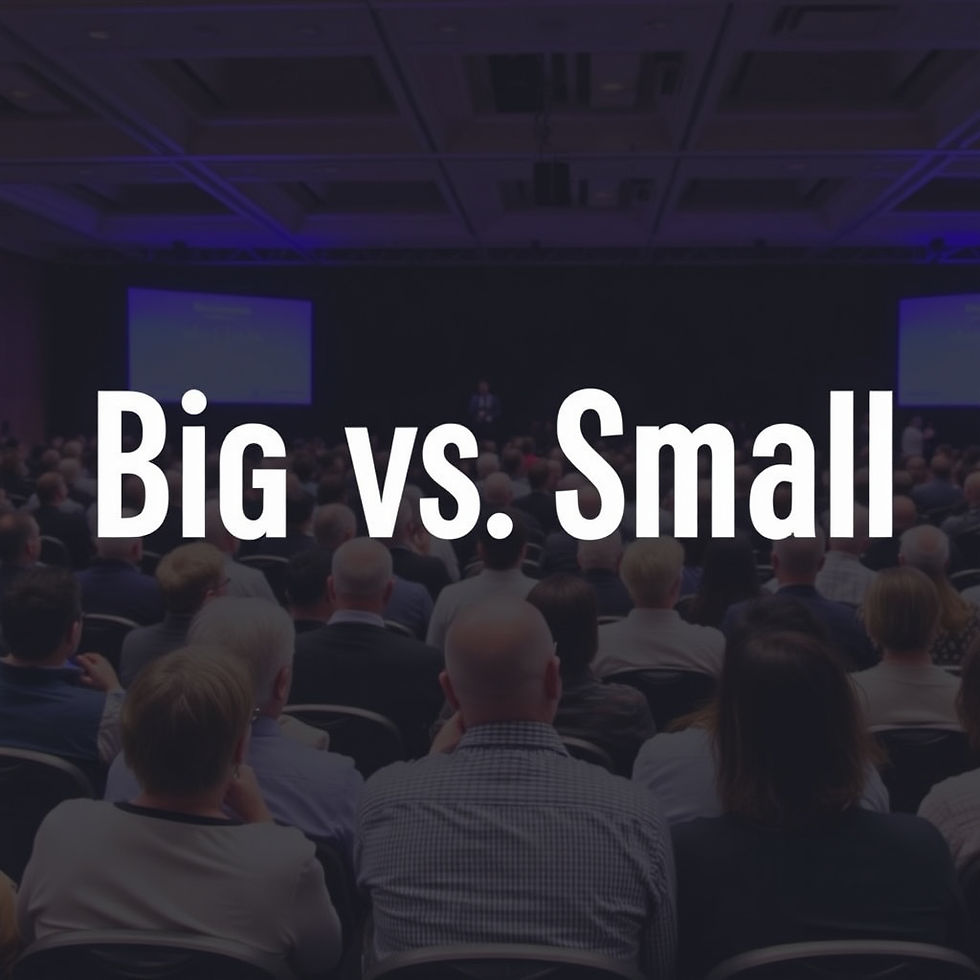
The hypnosis community is no exception.There is a debate that comes up in almost every professional conference community:
Do people really want a big conference—or would they rather attend a smaller event where they can actually know the people in the room?
On one side are large conferences with dozens of presenters, multiple tracks, exhibitors, major speakers, social events, and hundreds or even thousands of attendees.
On the other are smaller conferences that promise something very different: intimacy, easier networking, more personal interaction with presenters, and a feeling that you are part of a community rather than simply another person wearing a name badge.
So which one do people actually prefer?
The answer, based on the available research and what we can observe in the hypnosis community, is more complicated than “big is better” or “small is better.”
The evidence suggests something much more interesting: People don’t necessarily choose a conference because of its size. They choose it because of what that size allows them to experience.
And that distinction matters enormously for hypnosis conference organizers.
The first problem: There isn’t enough hypnosis-specific research
Before making a sweeping statement about what “hypnotists prefer,” we need to acknowledge an important limitation.
There is very little peer-reviewed research specifically measuring whether hypnosis professionals prefer large versus small hypnosis conferences.
That means anyone claiming that “hypnotists prefer small conferences” or “everyone wants the biggest conference possible” is probably overstating the evidence.
Instead, we have to triangulate.
We can look at research on professional and academic conferences; studies of conference attendance and satisfaction; research on networking; research on travel and attendance barriers; attendee discussions about hypnosis conferences; publicly available attendee reviews and comments; and the characteristics that appear to drive repeat attendance. When those sources are considered together, a fairly clear picture emerges.
Cost may matter more than conference size.
One of the strongest findings in conference research is surprisingly simple:
People care about the total cost of attending.
A 2022 conjoint analysis of academic conference attendance found that total attendance cost and the conference organizer were tied as the two most important attributes, each accounting for 28% of the relative importance in conference-selection decisions. Conference size was one of several other attributes considered.
This is important because conference price isn’t really the price of the ticket.
For someone attending a hypnosis conference, the real calculation may look like this:
Registration + hotel + airfare/gas + rental car/Uber + meals + time away from work + missed client appointments + additional training expenses.
That can turn a $200–$500 registration decision into a $1,000–$2,000 decision very quickly.
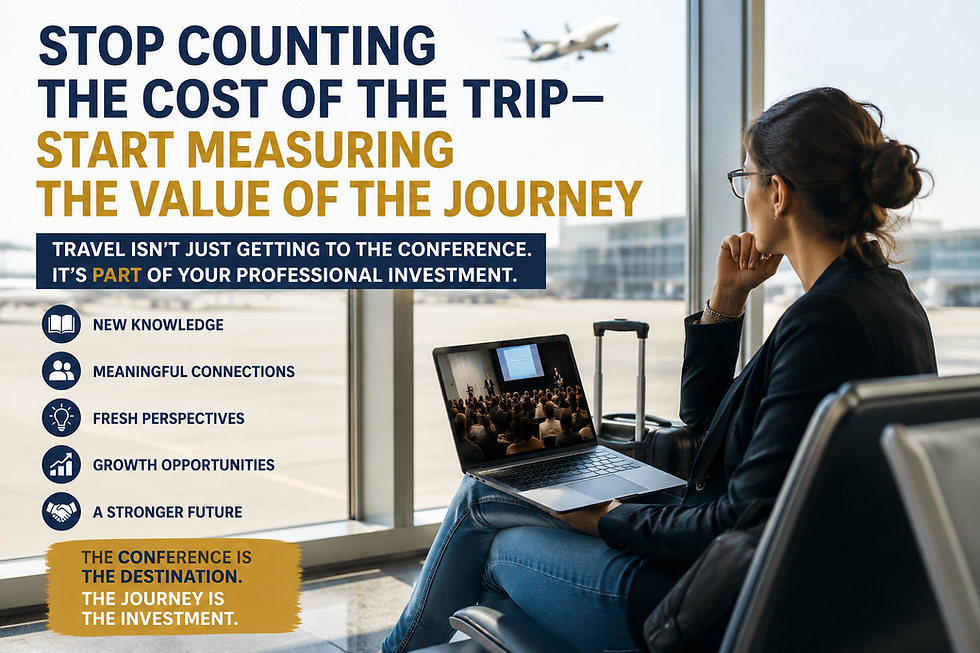
And travel continues to be a major concern for conference attendees generally. Research on conference participation repeatedly identifies travel, accommodation, registration cost, time, and convenience as barriers.
The meetings industry is seeing the same pressure.
Cvent’s 2026 meetings-industry data reported that 78% of planners identified travel and lodging costs as a major concern, while MPI has reported growing attendee price sensitivity as in-person registration costs rise.
This creates an interesting situation for hypnosis conferences. A smaller conference isn’t automatically cheaper.A large conference isn’t automatically more expensive.
The real question is the total value received for the total investment.
Why someone might choose a large hypnosis conference
Large conferences have an advantage that small conferences simply cannot reproduce:
Choice.
A large event can potentially offer more presenters; more specialties; more educational tracks; and more demonstrations as well as more networking possibilities;more vendors;more opportunities to discover new ideas.
More chances to meet people from outside your normal professional circle;
and greater exposure to nationally or internationally recognized presenters.
For someone who wants to explore the field, that variety can be extremely valuable.
Imagine a hypnotist who normally works in clinical hypnosis.
At a large event, they might be able to attend sessions on:
clinical practice → trauma → performance hypnosis → business → marketing → neuroscience → stage hypnosis → conversational hypnosis → research → advanced techniques.
That breadth is difficult for a small conference to duplicate.
And there is another advantage:
Serendipity.
You might travel to a large conference because you want to hear one particular speaker—and come home having met three people who eventually become business partners, collaborators, referral sources, friends, or co-presenters.
That possibility is one reason conferences continue to matter even when so much education is available online.
Deloitte’s corporate travel research found that conferences remain a major driver of business travel because they allow professionals to meet many clients and prospects in a short period of time.
In other words:
Large conferences can create a density of opportunity.
The hypnosis community appears to value this
Look at the discussions surrounding Large Hypnosis conferences .
Recent attendee discussions describe these events as a large hypnosis gatherings and include comments from people who have attended for years. Some describe it as “career changing,” fun, well organized, and having high-quality presenters.
Another discussion from 2025 shows a longtime attendee describing the event as a “great conference,” while also noting concerns about changes in presentation formats and the number and variety of sessions. That is revealing.
The complaint isn’t necessarily:
“It’s too big.”
Instead, the concerns are about whether the size produces enough meaningful educational value.
That is a very different problem.
But big conferences have a serious weakness: connection
Here is where smaller conferences begin to shine.
A conference can have 1,000 people in the room and still leave an attendee feeling like they barely met anyone.
Networking isn’t simply about the number of people present.
It is about the quality and accessibility of interactions.
Research consistently identifies networking as one of the central reasons professionals attend conferences. A 2007 study of convention attendees identified networking, convenience, educational benefits, and activities among the major dimensions of conference motivation—and found relationships between educational satisfaction, overall satisfaction, word-of-mouth, and intention to return.
Recent conference research tells a similar story.
In a 2026 study of participants at a critical-care academic conference, 61.2% considered networking important or very important, with group discussions and collaborative workshops among the most valued networking opportunities.
That has a major implication:
Networking isn’t necessarily improved by adding more people.
Sometimes adding people makes networking harder.

The “small conference advantage”
At a smaller event, you are more likely to encounter the same person several times.
You sit next to someone during breakfast. You see them again during a workshop. You talk to them during a break. Then you run into them at dinner. By the end of the weekend, you aren’t exchanging business cards with a stranger. You’re talking with someone you already know. That’s a fundamentally different networking experience.
Research and commentary on conference design have repeatedly pointed toward this phenomenon: smaller environments make deeper interaction easier, while very large events can make it harder for attendees to move beyond existing social circles.
A recent analysis of mega-conferences argues that large events can actually produce valuable “social infrastructure”—collaborations, mentoring relationships, and professional friendships—but that those benefits often come from the informal interactions surrounding the formal program rather than from sitting in large sessions.
That is a critical distinction.
Large conferences create more potential connections.
Small conferences can make it easier to deepen those connections.
What about the speakers?
This may be one of the biggest differences between large and small conferences.
At a large conference, you may get access to an extraordinary lineup of speakers.
But access doesn’t necessarily mean interaction.
You might sit in a room with 300 people and listen to a speaker for 90 minutes.
Then the session ends. The speaker disappears into the crowd. At a smaller conference, there is often greater opportunity for: informal conversations; questions after presentations; meals with presenters; smaller workshops; direct feedback; mentorship;
and continuing conversations throughout the weekend.
For some attendees, that interaction is more valuable than another presentation.
In one recent conference study, participants specifically identified meeting prominent speakers as a major networking benefit, while group discussions and collaborative workshops were highly valued networking formats.
So when someone says:
“I want to go because Speaker X is presenting,”
the real question should be:
“What kind of access will I have to Speaker X?”
A big-name speaker on a stage isn’t necessarily the same experience as a big-name speaker sitting at your lunch table.
Speaker quality matters—but speaker quantity can become a trap.
There is another issue that large conferences face.
More speakers sound better.
But more isn’t necessarily better.
If a conference has 100 presenters, attendees may be forced to make difficult choices between simultaneous sessions.
They may also experience: session overcrowding; fragmented programming; inconsistent presentation quality; repetitive topics; shorter sessions; difficulty deciding what to attend; and the feeling that they are constantly missing something.
Interestingly, this is reflected in attendee discussions surrounding large hypnosis conferences.
One longtime HypnoThoughts Live attendee noted that changes to session length allowed more presenters, but also meant some sessions had only a handful of attendees. (Reddit)
That is the paradox:
More choices can create less satisfaction if attendees feel they are constantly choosing what they cannot experience.
Small conferences have the opposite problem.
Smaller isn’t automatically better either.
A small conference can become:
too limited in subject matter; overly dependent on a handful of speakers;
repetitive; insular; difficult for newcomers to break into; or financially difficult to sustain.
And if the attendee paid significant travel costs to attend, they may reasonably expect a substantial educational program.
A person traveling 800 miles to attend a conference may not be satisfied with six presentations simply because the event was intimate.
This is why conference size cannot be evaluated independently from the program.
The travel question changes everything.
For hypnosis professionals, travel is particularly important because many attendees are independent practitioners.
They may not have:corporate travel budgets;professional development reimbursement;paid conference leave;employer-paid hotels;or a company paying for airfare. They are often paying out of their own business or personal income.
Research across conference communities consistently identifies travel and accommodation costs as significant attendance barriers.
A survey of conference participants in the cognitive sciences, for example, identified monetary cost, distance, location, networking, and relevance among the factors influencing attendance, with cost particularly important for people whose travel isn’t institutionally funded.
This creates an important distinction between two kinds of conference value.
Educational value
“What did I learn?”
Professional value
“Who did I meet?”
Financial value
“Did this help my business?”
Personal value
“Did I have an experience that made the trip worthwhile?”
A large conference may win on education and breadth. A smaller conference may win on relationships.
And either can win on ROI if the attendee turns those experiences into something meaningful.
Attendee reviews tell us something important.
Public attendee comments are not scientific surveys.
They are self-selected, anecdotal, and often represent people with particularly strong opinions.
But they can still reveal themes.
Hypnosis conference discussions show both sides.
Some attendees describe large hypnosis events as highly valuable, enjoyable, educational, and professionally important. Others criticize cost, perceived sales pressure, educational fit, or the overall experience. (Reddit)
That disagreement is actually useful.
It tells us something:
There may not be one “hypnosis conference attendee.”
There are different attendee types.
The five types of conference attendee
The Explorer
This person wants exposure to as much of the field as possible.
They love large conferences.
Give them 80 speakers and 10 tracks and they’re happy.
Their question is:
“What else can I discover?”
The Connector
This person is primarily attending to build relationships.
They want conversations, meals, collaborations, friendships and referrals.
They may prefer smaller conferences—or large conferences with deliberately designed small-group networking.
Their question is:
“Who am I going to meet?”
The Specialist
This attendee wants advanced education.
They aren’t interested in 50 introductory sessions.
They want the best presenter on a particular topic.
They might prefer either size depending on programming quality.
Their question is:
“Will I learn something I can actually use?”
. The Business Builder
This person evaluates conferences through ROI.
They are thinking:
Will I get clients? Will I build referral relationships? Will I meet potential collaborators?
Will I sell services? Will I find business partners?
For this person, networking may be more valuable than another lecture.
Their question is:
“Will this investment produce a return?”
The Community Member
This person wants belonging. They want to see people they know. They want to make friends.
They want to feel like they are part of something bigger than themselves. For this person, a conference can become an annual family reunion.Their question is:
“Where are my people?”
And this is where the debate becomes much more interesting.
If you ask:
“Do people prefer large conferences or small conferences?”
you may be asking the wrong question.
The better question is:
“What do attendees want the conference to help them accomplish?”
Because the answer changes the preferred size.
Someone seeking exposure to dozens of ideas may prefer a large event.
Someone trying to build five meaningful relationships may prefer a smaller one.
Someone wanting one particular expert may not care about size at all.
Someone with a limited budget may prioritize geographic proximity and total cost.
Someone traveling internationally may be willing to spend significantly more if the event provides exceptional value.
The sweet spot may actually be a hybrid of big and small
This may be the most important finding for hypnosis conference organizers.
The future may not belong exclusively to large conferences.
And it may not belong exclusively to small conferences.
It may belong to large conferences that feel small.
Think about what that means.
A conference can have hundreds of attendees while creating smaller communities inside the larger event:
hosted networking tables;topic-specific lunches;small roundtables;presenter meet-and-greets;
collaborative workshops;structured introductions;first-time attendee gatherings;special-interest groups;
small dinners; mentorship opportunities; and informal discussion areas.
In other words:
Use the scale of a large conference to create opportunity—but use the intimacy of a small conference to create connection.
Recent conference-design thinking increasingly points in this direction: large events can benefit from intentionally creating small, hosted networking experiences within the larger gathering. (All Along)
What does this mean for hypnosis conferences?
There is a lesson here for every hypnosis conference organizer.
Don’t compete only on attendance numbers.
“We have 500 attendees” is impressive.
But it doesn’t necessarily tell a potential attendee why they should spend $500, $1,000 or $1,500 to be there.
Likewise:
“We’re an intimate conference of 100 people” sounds attractive.
But intimacy by itself isn’t enough.
The real value proposition should be:
What will happen because I attended?
Will I: learn a technique I can use Monday morning? meet someone who changes my career?
build a referral relationship? discover a new area of hypnosis? find a mentor? meet future collaborators? become more confident? make lifelong friends? hear an important speaker? experience something I couldn’t get online?
That’s what attendees are actually buying.
Price should be judged against the experience—not against the ticket.
This is especially important in the hypnosis community.
A $150 conference isn’t automatically a bargain.
A $500 conference isn’t automatically expensive.
The attendee is really comparing:
Total cost ÷ perceived value.
A $200 registration plus $1,000 in travel expenses can feel expensive if the attendee sits through presentations they could have watched online.
Conversely, a $400 registration plus $1,000 in travel can feel like an incredible investment if the attendee leaves with:
new skills;new friendships;new business;new collaborations;
and a completely different perspective on their career.
The academic conference literature reinforces this point: cost is one of the strongest factors affecting conference choice, while education, networking, professional development and satisfaction influence the perceived value of the experience.
So, do hypnotists prefer large or small conferences?
Based on the available evidence, there is no defensible basis for saying the hypnosis community universally prefers one or the other.
But there is enough evidence to make a much stronger statement:
Hypnosis professionals appear likely to value the benefits associated with both models—and the most successful conferences are the ones that intentionally deliver those benefits.
Large conferences offer:
Breadth.Choice.Exposure.
Prestige.More presenters.More potential connections.More opportunities for discovery.
Small conferences offer:
Intimacy.Accessibility.Community.Deeper conversations.Easier networking.
Greater presenter interaction.A stronger sense of belonging.
The ideal conference doesn’t necessarily choose one.
It combines them.
The future of hypnosis conferences may be “big enough to matter, small enough to connect”
This may be the real sweet spot.
A conference doesn’t have to become enormous to be successful.
And it doesn’t have to remain tiny to feel personal.
The goal should be to create an experience where attendees can say:
“There were enough people there that I met new people—but not so many that I felt invisible.”
“There were enough speakers that I had choices—but not so many that the program felt overwhelming.”
“The conference was professional—but it still felt personal.”
“I learned a lot—but I also had conversations that changed the way I think.”
“I spent money to attend—but I can explain exactly why it was worth it.”
That is a much more meaningful definition of conference success than attendance numbers alone.
The Bottom Line
The hypnosis community probably doesn’t have a simple large versus small preference.
It has a value versus experience preference.
People want to know that their money, time, and travel were worth it.
They want great speakers. They want useful education. They want meaningful relationships.
They want opportunities.
They want community.
And increasingly, they want conferences that recognize that attending an event isn’t simply purchasing a seat in a room.
It is investing in their professional development.
That is why the best conference strategy may not be to ask:
“How big can we make this?”
or
“How small can we keep this?”
The better question is:
“How can we create the greatest possible value for every person who makes the decision to be in the room?”
Because at the end of the day, attendees don’t remember the size of the ballroom.
They remember the people they met, the things they learned, the conversations they had, and what happened after they went home.
And that may be the real measure of a great hypnosis conference.


Comments